
That number surprises people. Then they look at the plate. Nobody stops at one tablespoon of ketchup with fries.
The numbers
USDA averages for standard ketchup, 17 grams per tablespoon.
| Ketchup on the plate | Sugar | Share of a 25 g day | Share of a 36 g day |
|---|---|---|---|
| 1 tablespoon | About 3.6 g | 14% | 10% |
| 2 tablespoons | About 7 g | 29% | 20% |
| 3 tablespoons | About 11 g | 43% | 30% |
| 1 packet (about 9 g) | About 2 g | 8% | 5% |
The 25 and 36 gram figures are the American Heart Association's suggested daily limits for added sugar for most women and most men. The FDA's Daily Value on the label is higher: 50 grams.
Why this matters. Ketchup is not soda. A 12-ounce can of regular cola has about 39 grams of sugar. But ketchup is on the table most days, and a heavy hand turns a small number into a real one.
Where the sugar comes from
Two places.
The tomato. Ripe tomatoes have natural sugar. Cooking them down into paste concentrates it.
The sweetener. Tomatoes are tart and vinegar is sharp. Every ketchup recipe adds something sweet to balance them. That is the part you get to choose.
The label splits these. "Total Sugars" is everything. "Includes Added Sugars" is the part the recipe put in.
Real sugar or high fructose corn syrup
Many of the best-selling ketchups are sweetened with high fructose corn syrup. It is a liquid sweetener made from corn starch. It is cheaper than sugar and easier to ship.
The gram count on the panel can look the same either way. The ingredient list is where the difference shows.
| Real sugar | High fructose corn syrup | |
|---|---|---|
| What it is | Sucrose | Liquid sweetener from corn starch |
| Why brands use it | Clean, familiar sweetness | Lower cost |
| How to spot it | "Sugar" | "High fructose corn syrup" or "corn syrup" |
A 2022 systematic review in Frontiers in Nutrition found high fructose corn syrup intake was associated with higher C-reactive protein, an inflammation marker, compared with regular sugar. If both do the same job in the bottle, real sugar is the easier one to defend.
What about "no sugar added" ketchup
Those bottles drop the added sugar and usually replace it with another sweetener. Some people like them. Read the ingredient list and decide if you want what took the sugar's place.
Read any bottle in ten seconds
- Find the serving size. It is one tablespoon. Be honest about how many you use.
- Read "Includes Added Sugars." That is the recipe's choice, not the tomato's.
- Find the sweetener in the ingredients. Sugar, or syrup.
- Check what comes first. It should be tomatoes.
The bottom line
Ketchup has about a teaspoon of sugar per tablespoon. Use it like a condiment and it is a small part of your day. The better question is what kind of sweetener is in the bottle.
78 Original Ketchup is 78% tomatoes and sweetened with real sugar. No high fructose corn syrup. Non-GMO and gluten-free. The exact numbers are on our label.
Keep reading: Is ketchup healthy? and what is actually in your ketchup.
Sources
- USDA FoodData Central, ketchup (catsup) nutrient data. https://fdc.nal.usda.gov/
- Harvard T.H. Chan School of Public Health, Added Sugar, for the FDA Daily Value and American Heart Association limits. https://nutritionsource.hsph.harvard.edu/carbohydrates/added-sugar-in-the-diet/
- Frontiers in Nutrition (2022), systematic review and meta-analysis on HFCS and inflammatory markers. https://www.frontiersin.org/journals/nutrition/articles/10.3389/fnut.2022.1013310/full
- U.S. Food and Drug Administration, Added Sugars on the Nutrition Facts Label. https://www.fda.gov/food/nutrition-facts-label/added-sugars-nutrition-facts-label
Keep reading
Is ketchup healthy?
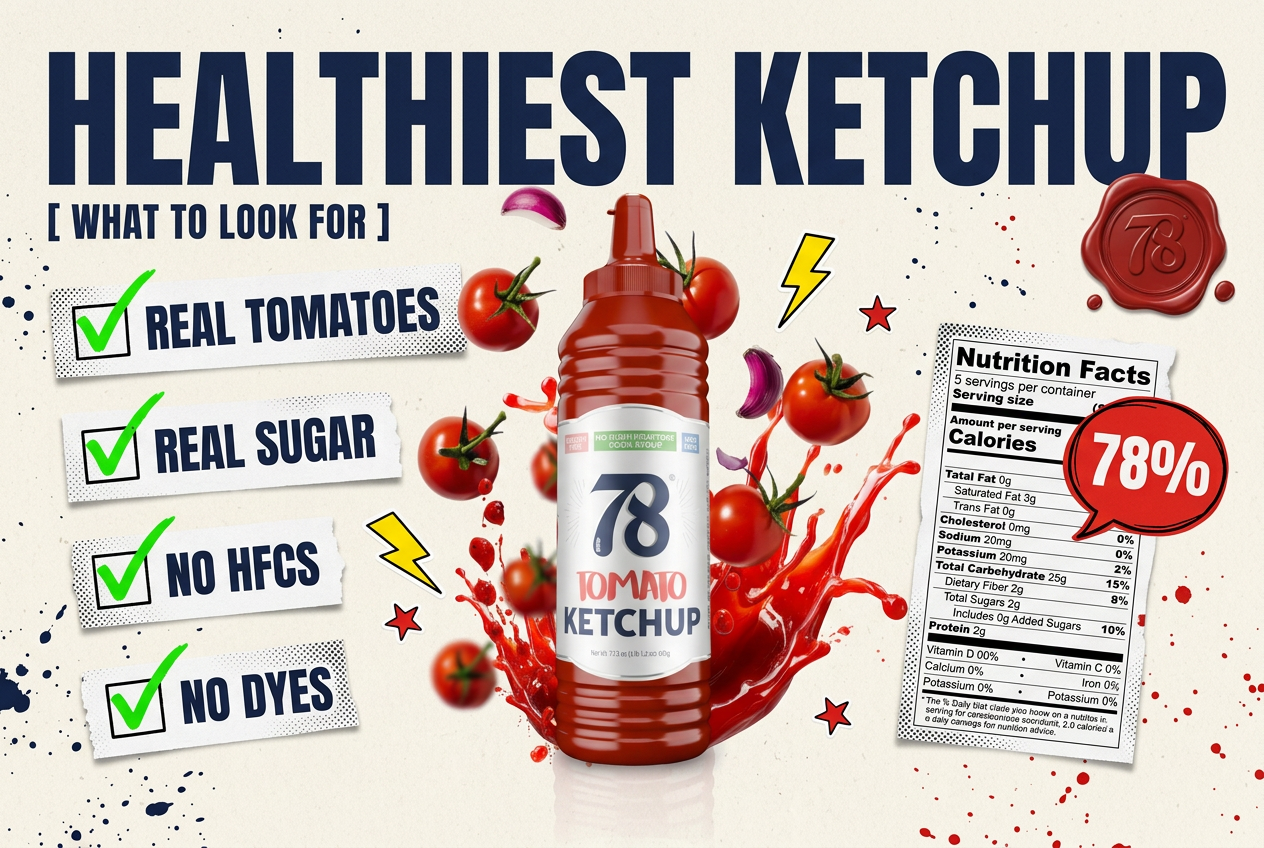
Is ketchup healthy? A tablespoon has about 17 calories and 4g of sugar. Here is what matters on the label and how to pick the healthiest ketchup.
Read article →
what is actually in your ketchup
What ketchup is really made of: tomato paste, Brix, and real sugar. A plain guide to reading any bottle in about ten seconds.
Read article →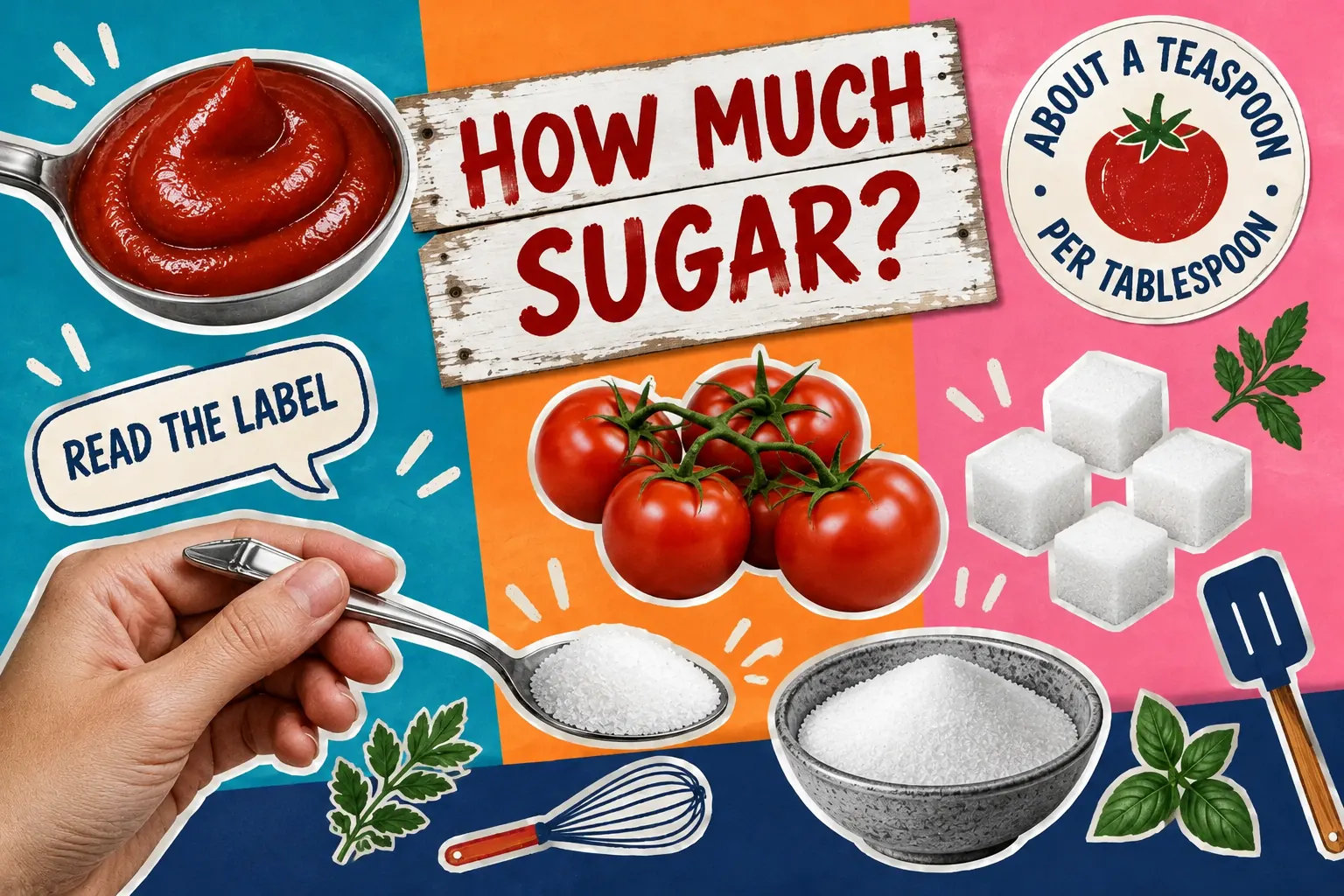
How Much Sugar Is in Ketchup? About a Teaspoon per Tablespoon
How much sugar is in ketchup? About 3.6 grams per tablespoon, just under a teaspoon. See where it comes from and how to read the label in 10 seconds.
Read article →