Most people reach for the ketchup bottle without thinking twice about it. It's ketchup. Tomatoes, vinegar, something sweet. It goes on burgers and eggs and fries and that's about as far as the thought goes.
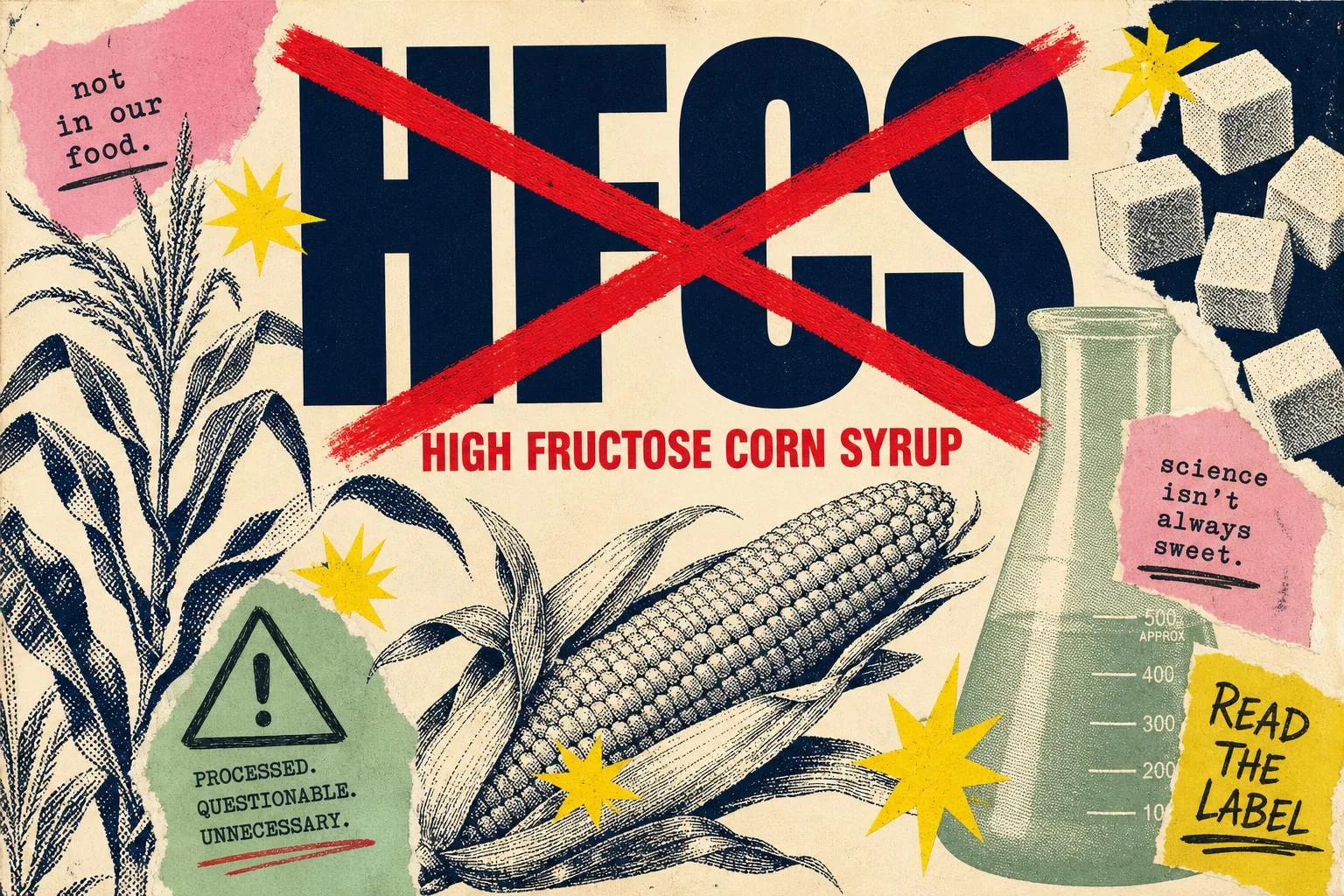
But flip that bottle over and read the ingredients label. On most of the best-known brands in America, sitting right after tomato concentrate and distilled vinegar, you'll find it: high fructose corn syrup. Not sugar. A liquid sweetener engineered in a laboratory, manufactured from field corn, and added to your condiments, your salad dressings, your bread, your cereal, and hundreds of other foods you probably don't think of as sweet.
Understanding what high fructose corn syrup actually is, where it comes from, how your body processes it differently from real sugar, and what the research says about its long-term effects, matters. Not because ketchup is going to kill you. But because most Americans are consuming this ingredient dozens of times a day without knowing it, and the body keeps score.
What is high fructose corn syrup?
High fructose corn syrup (HFCS) is a liquid sweetener derived from corn starch. It has been in the American food supply since the early 1970s, when a combination of U.S. sugar import quotas, corn subsidies, and a newly refined industrial enzyme process made it dramatically cheaper to produce than beet or cane sugar.
The food industry noticed immediately. By 1999, HFCS had become the dominant sweetener in American processed food. Consumption peaked at nearly 66 pounds per person per year, according to figures cited in Michael Pollan's The Omnivore's Dilemma. It took decades for that number to start declining, and it remains in the tens of pounds annually for the average American.
HFCS comes in several formulations. The two most common are:
| Type | Fructose | Glucose | Common uses |
|---|---|---|---|
| HFCS-42 | 42% | 58% | Baked goods, cereals, canned goods |
| HFCS-55 | 55% | 45% | Sodas, condiments, ketchup |
| HFCS-90 | 90% | 10% | Used to blend down to HFCS-55 |
The number refers to the percentage of fructose in the syrup. Table sugar (sucrose) is 50% fructose and 50% glucose. So HFCS-55, the version used in most ketchup, has slightly more fructose than regular sugar. That difference matters more than it sounds, for reasons we'll get to.
How high fructose corn syrup is made
This part is worth understanding, because it helps explain why HFCS behaves differently in your body than sugar that has been refined from beets or cane.
The process starts with field corn, not the sweet corn you'd eat off a cob, but commodity starch corn grown by the billions of bushels across the American Midwest. Here's how it becomes the sweetener in your food:
- Step 1: Starch extraction. The corn is milled to separate the starch from the protein, fiber, and oil.
- Step 2: Liquefaction. The starch is mixed with water and an enzyme called alpha-amylase, which breaks the starch into shorter chains called dextrins.
- Step 3: Saccharification. A second enzyme, glucoamylase, breaks the dextrins all the way down into glucose, a simple sugar your body recognizes.
- Step 4: Isomerization. A third enzyme, glucose isomerase, converts a portion of that glucose into fructose. This is what makes HFCS different from regular corn syrup (which is pure glucose) and what gives it its sweetness.
- Step 5: Filtration and concentration. The resulting liquid is filtered through ion-exchange resins to remove impurities, then run through liquid chromatography to concentrate the fructose to the desired percentage.
The finished product is a clear, sweet liquid. It has no seeds, no fiber, no plant context. It has been stripped of everything except the sugar molecules, and critically, those molecules are no longer chemically bonded together the way they are in real sugar. That structural difference is where the health story begins.
Why liquid sweeteners hit your body differently
Before we get to the research, there's one point that doesn't get enough attention: the fact that HFCS is a liquid is not incidental. It's central to how it behaves in your body.
When you eat solid food containing sugar, digestion takes time. Chewing, stomach processing, and intestinal absorption all slow the delivery of sugar into your bloodstream. Your body has a chance to pace itself.
Liquid sweeteners bypass most of that. They move through digestion faster, arrive in the bloodstream more quickly, and deliver a larger sweetener load to the liver in a shorter window of time. This is true of all liquid sugar sources, sodas, juice drinks, sweetened sauces, but HFCS compounds the effect because its fructose and glucose are already separated at the molecular level. There's no bond for your body to break. It's pre-digested by industrial enzymes before it ever reaches your mouth.
The result is a faster, larger fructose load arriving at the liver than your body is built to efficiently manage. That's the mechanism behind most of the research findings below.
Why this matters. The speed and form of sweetener delivery isn't just a chemistry footnote. It's the difference between your body managing sugar as a gradual fuel source and being flooded by it all at once. Solid foods containing real sugar give your digestive system time to work. Liquid HFCS doesn't extend that courtesy.
Why HFCS isn't the same as sugar, even when the numbers look similar
"Fructose is almost entirely cleared by the liver. Hepatic metabolism of fructose stimulates lipogenesis. These events are independent of insulin exertion and phosphofructokinase regulation."
In table sugar, fructose and glucose are chemically bonded together in a molecule called sucrose. Your body has to break that bond before it can absorb either component. That process happens in your small intestine and takes time.
In HFCS, the fructose and glucose are already separated, free-floating in liquid form. They're absorbed faster, and they arrive at the liver without the molecular structure that normally signals the digestive system to pace itself.
Glucose can be used by virtually every cell in your body. It raises blood sugar, triggers insulin, and gets delivered as energy to your muscles, your brain, and your organs. Your whole metabolic system is designed to handle glucose, it's the primary fuel.
Fructose is different. Most cells in your body have limited capacity to absorb it. Almost all of it goes directly to the liver, which is left to deal with the entire load. And the liver, faced with that load, does something predictable: it converts fructose to fat.
This process, called de novo lipogenesis, is well documented in the scientific literature. A 2025 systematic review published in Frontiers in Nutrition found that HFCS promotes hepatocellular triglyceride accumulation and hepatic steatosis through increased lipogenesis and impaired insulin signaling. In plain terms: repeated high-dose HFCS consumption contributes to fatty liver and makes cells less responsive to insulin.
The health effects: what the research actually shows
1. Fatty liver disease
This is where the research is most consistent. A 2018 paper in the Journal of Hepatology, one of the most cited studies on this topic, concluded that "sucrose and HFCS are likely major risk factors for NAFLD" (non-alcoholic fatty liver disease). The mechanism: fructose metabolism activates an enzyme called fructokinase C, which depletes cellular ATP, generates uric acid, and creates the conditions for fat to accumulate in the liver rather than be burned.
NAFLD affects an estimated 70 million people in the United States. It's now the most common liver disease in the developed world, and its rise tracks closely with the expanded use of HFCS across the food supply.
Why this matters. Your liver does over 500 jobs: filtering toxins, producing bile, managing cholesterol, regulating blood sugar. Fatty liver disease impairs all of them. It's also a gateway to more serious conditions including hepatic fibrosis, cirrhosis, and liver failure. You don't have to be a heavy drinker to develop it.
2. Metabolic syndrome and insulin resistance
A 2025 meta-analysis published in PubMed Central found that some HFCS interventions showed marked increases in uric acid, a metabolic marker linked to gout, kidney disease, and cardiovascular risk. A separate NIH-funded study published in the Journal of Clinical Endocrinology & Metabolism found that consuming HFCS-sweetened beverages at 25% of daily energy intake for just 16 days increased hepatic lipid content and decreased insulin sensitivity in healthy young adults.
Not people with pre-existing conditions. Healthy adults, in a controlled clinical setting, over two weeks.
Insulin resistance means your cells stop responding efficiently to insulin's signal to absorb glucose from the blood. The pancreas compensates by producing more insulin. Over time, it can't keep up. That's the metabolic pathway to type 2 diabetes.
3. Appetite disruption
Your body has two key hormones that regulate hunger: leptin, which signals fullness, and ghrelin, which signals hunger. A healthy meal suppresses ghrelin and increases leptin. You eat, you feel full, you stop.
HFCS complicates this loop. Research published in Nutrition & Diabetes found that HFCS feeding induced more severe adipose inflammation and insulin resistance in animal studies than even a higher-calorie Western diet. One mechanism: fructose consumption doesn't suppress ghrelin as efficiently as glucose does. The "I've had enough" signal gets weaker.
4. Gut microbiome disruption
A 2022 study published in npj Science of Food found that HFCS significantly increased body fat content and altered intestinal microbiome structure, including reducing populations of bacteria that negatively correlate with body fat. This is an area where research in humans is still developing, but the directional finding is consistent across multiple studies: high fructose intake reshapes gut bacteria in ways that appear to favor fat storage over metabolic health.
The honest counterargument
It would be dishonest not to mention this: some researchers, particularly those studying short-term, controlled settings, have found that HFCS and sucrose produce similar metabolic outcomes when consumed in equivalent amounts.
A study published in Applied Physiology, Nutrition, and Metabolism, funded by the Corn Refiners Association, found that under "real world conditions," HFCS did not increase liver fat or contribute to insulin resistance differently than sucrose. Some researchers have argued that the fructose-to-glucose ratio in HFCS-55 is close enough to table sugar that the metabolic differences are minimal at equal doses.
The honest read on the science: the debate at the molecular level isn't fully closed. What is settled is that fructose, in high quantities, in liquid form, consumed regularly across multiple products in a single day, is hard on the liver and disrupts the body's energy regulation systems.
That's the real issue. It's not ketchup in isolation. It's ketchup plus the salad dressing plus the bread plus the cereal plus the soda plus the granola bar, all in the same day, all containing liquid HFCS.
HFCS vs. real sugar: what's actually different
| Beet or cane sugar | High fructose corn syrup | |
|---|---|---|
| Source | Sugar beets or sugar cane | Corn starch |
| Form | Solid crystals (dissolved in use) | Liquid, pre-dissolved |
| Structure | Fructose + glucose bonded (sucrose) | Fructose + glucose free-floating |
| Fructose content | 50% | 42 to 55% (varies by type) |
| Absorption speed | Slower, bond must be broken first | Faster, pre-separated |
| Liver load | Moderate, paced by digestion | Concentrated, arrives faster |
| Insulin response | Normal | Fructose bypasses insulin pathway |
| Non-GMO options | Yes, widely available | Derived from GMO corn in most U.S. production |
| EU regulatory status | Standard food ingredient | Economically marginal; rarely used |
Why we use beet sugar at 78 Brand, and why it matters
We produce 78 Ketchup in Europe, where food ingredient standards are among the strictest in the world. HFCS isn't banned there, but it's rarely used, largely because European sugar policy makes beet sugar economically competitive in a way it simply isn't in the United States.
That context shaped our decision. When we were formulating 78 Ketchup, using real beet sugar wasn't a difficult call. It was the obvious one.
Beet sugar is a natural sweetener. It's produced from sugar beets, a root vegetable, through a straightforward extraction and refining process. The end result is sucrose: the same molecule your body has been processing for thousands of years. No enzymatic conversion. No industrial isomerization. No free-floating fructose arriving at your liver ahead of schedule.
It's also non-GMO. And that matters to us, not as a marketing claim, but as a product philosophy.
The corn used to produce most HFCS in the United States is genetically modified. GMO ingredients are not inherently dangerous, and the science on food safety for approved GMO crops is generally reassuring. But "generally recognized as safe" and "the best ingredient for a quality product" are two different standards. In Poland and across much of Europe, GMO foods face strict regulations or outright bans in many categories, a reflection of a food culture that sets a higher bar for what goes into everyday products.
We align with that standard. If we're going to put 78 Brand's name on a bottle of ketchup and ask you to trust us, the least we can do is use a sweetener that your body recognizes, that comes from a plant you can picture, and that doesn't require a laboratory process most people have never heard of.
We'll be writing more about GMOs, what they are, and how to read labels for them in an upcoming post. Read: What is a GMO? A plain-language guide →
It's also worth saying: beet sugar's cost is genuinely competitive at the volumes we produce. We're not paying a premium to use real sugar and passing that cost to you. The promise of 78 Brand has always been quality that doesn't ask you to choose between good food and an affordable price. Beet sugar lets us keep that promise.
More choices than ever, and the choice is yours
The ketchup aisle looks different than it did ten years ago. That's a good thing.
Consumers started asking questions about ingredients, and the market responded. More brands now offer ketchup made with real sugar, organic formulations, reduced-sugar options, and cleaner ingredient lists. The conversation about what's in everyday condiments has shifted in a meaningful direction, and we're genuinely glad to see it.
We don't think you need to vilify any particular brand to make an informed choice. The information is on the label. Once you know what you're looking at, once you understand what high fructose corn syrup is, how it's made, and how it differs from real sugar, you can decide for yourself what you want on your table.
That's what this article is for. Not to tell you what to buy. To give you what you need to decide.
What to look for on labels
If you want to avoid HFCS, you have to read the ingredient list, not just the front of the package. Here's what to look for:
- High fructose corn syrup, the full name, used in most ingredient lists.
- Corn syrup, sometimes used interchangeably.
- Fructose or fructose syrup, can indicate HFCS under alternative naming.
- "Sugar" listed as the sole sweetener, with no corn syrup anywhere in the list, this is what you're looking for.
Labels that say "made with real sugar," or list only "sugar" or "beet sugar" or "cane sugar" as the sweetener, mean you're getting sucrose, the same molecule that's been sweetening food for centuries.
The bottom line
High fructose corn syrup is a manufactured liquid sweetener that has dominated the American food supply for fifty years. It's cheaper than beet or cane sugar, shelf-stable, and industrially convenient. The research on its health effects is nuanced but directionally consistent: high fructose consumption, particularly in liquid form, delivered quickly, repeated across multiple products every day, places a burden on the liver and disrupts the metabolic systems that regulate hunger, fat storage, and insulin sensitivity.
You now have the information. The choice on the shelf is yours, and the fact that there are real choices to make is worth appreciating.
78 Brand Ketchup is made in Europe with real non-GMO beet sugar, quality tomatoes, and no high fructose corn syrup. We believe good food shouldn't require a chemistry lesson to understand.
Frequently asked questions
- Is high fructose corn syrup worse than regular sugar?
- The science is debated at equivalent doses, but most independent research suggests that HFCS, particularly in liquid form across multiple daily servings, places a heavier burden on the liver than solid beet or cane sugar does. The structural difference matters: HFCS delivers free-floating fructose that absorbs faster and arrives at the liver in a larger, quicker load. The more relevant question is cumulative exposure: if HFCS appears in your ketchup, your bread, your salad dressing, and your cereal on the same day, the total fructose load compounds in ways that single-serving comparison studies don't capture.
- Why is HFCS in ketchup at all?
- Cost and convenience. In the United States, corn subsidies and sugar import quotas have historically made HFCS 20 to 30 percent cheaper than beet or cane sugar. It's a liquid that blends easily into condiments, and it extends shelf life. The economics that put it in ketchup are the same economics that put it in bread, cereal, and salad dressing. It wasn't chosen for nutritional reasons, it was chosen for manufacturing efficiency.
- What's the difference between HFCS and beet sugar?
- Beet sugar is sucrose, fructose and glucose bonded together in a single molecule, extracted from sugar beets through a natural refining process. HFCS is produced industrially from corn starch, with the fructose and glucose left separated. Your body has to break the bond in sucrose before absorbing it, which slows the delivery. With HFCS, that step is already done. The result is faster absorption and a larger fructose load delivered to the liver at once.
- Is HFCS a GMO ingredient?
- The corn used to produce the majority of HFCS in the United States is genetically modified. While approved GMO crops are generally considered safe by regulatory agencies, many consumers and food producers, particularly in Europe where GMO foods face strict regulations or bans in many countries, prefer non-GMO alternatives.
- What does HFCS do to the liver?
- Multiple peer-reviewed studies have found that high fructose intake promotes fat accumulation in the liver through a process called de novo lipogenesis. Over time, this is associated with non-alcoholic fatty liver disease (NAFLD), which affects an estimated 70 million Americans. The liver processes nearly all dietary fructose, and repeated high-dose liquid exposure can impair its insulin signaling and promote oxidative stress.
- Is HFCS banned in Europe?
- HFCS is not banned in Europe, but it's rarely used, largely because EU agricultural policy makes beet sugar economically competitive in a way it isn't in the United States. European food culture also tends to apply a more precautionary standard to novel processed ingredients. The practical result is that most European food products, including our ketchup, are sweetened with beet sugar by default.
Sources
- 1.Yu et al. (2025). The impact of high fructose corn syrup on liver injury and glucose metabolism: a systematic review. Frontiers in Nutrition. View source
- 2.Jensen T. et al. (2018). Fructose and sugar: A major mediator of non-alcoholic fatty liver disease. Journal of Hepatology, 68(5):1063 to 1075. View source
- 3.Stanhope KL et al. (2021). Consuming sucrose or HFCS sweetened beverages increases hepatic lipid and decreases insulin sensitivity in adults. Journal of Clinical Endocrinology & Metabolism, 106(11). View source
- 4.Basaranoglu M. et al. (2014). Carbohydrate intake and nonalcoholic fatty liver disease: fructose as a weapon of mass destruction. HepatoBiliary Surgery and Nutrition. View source
- 5.Wang X. et al. (2022). Effects of high fructose corn syrup on intestinal microbiota structure and obesity in mice. npj Science of Food. View source
- 6.Stanhope KL. (2008). High-fructose corn syrup, energy intake, and appetite regulation. American Journal of Clinical Nutrition, 88(6). View source
- 7.Li Y. et al. (2017). Ghrelin receptor regulates HFCS induced adipose inflammation and insulin resistance. Nutrition & Diabetes. View source
- 8.Fernandes (2018) / Souzanchi et al. (2019). High-fructose corn syrup production and its new applications. ScienceDirect. View source
- 9.DeChristopher L. & Tucker K. (2025). Disproportionately higher asthma risk and incidence with high fructose corn syrup, but not sucrose intake, among Black young adults: the CARDIA Study. Public Health Nutrition. View source