
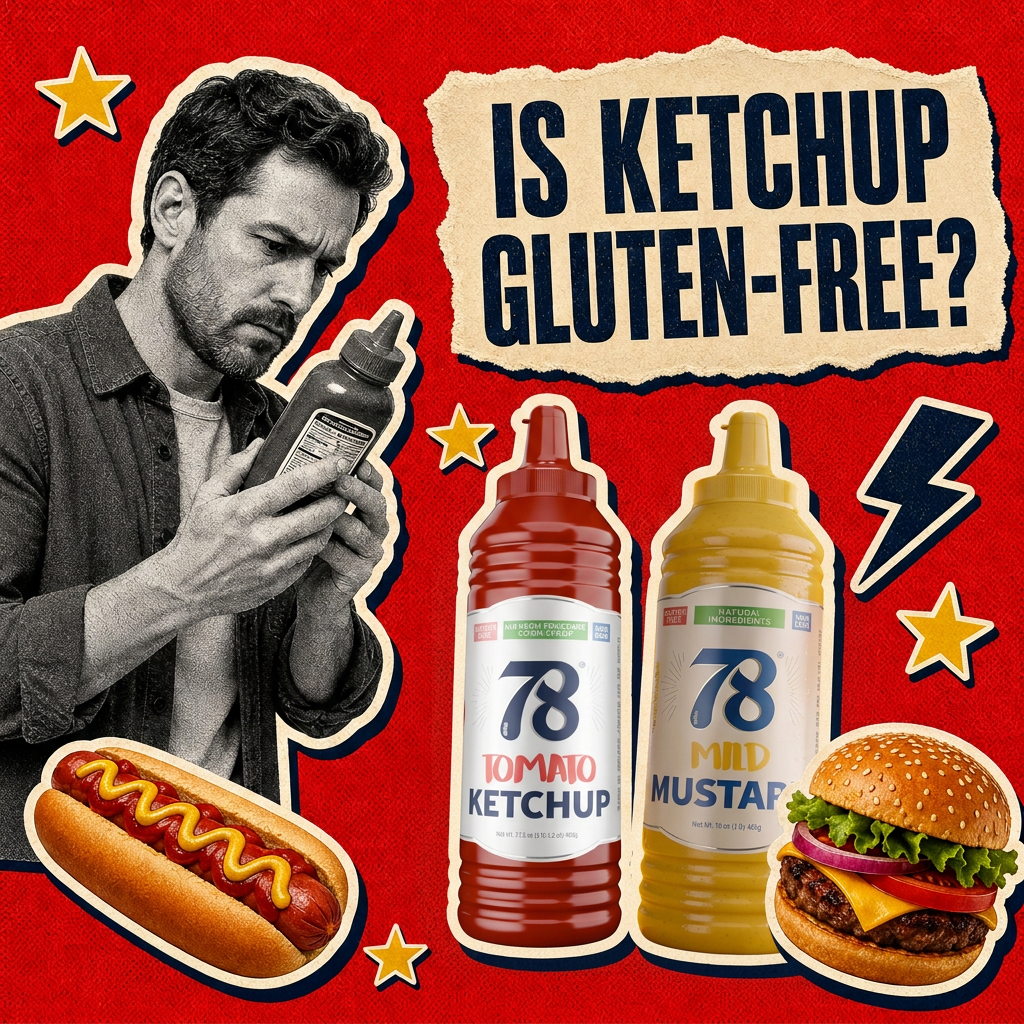
The burgers are coming off the grill and someone is standing at the condiment table with a ketchup bottle turned around, reading the back. They are not checking calories. They are looking for one word.
If you have celiac disease or a gluten sensitivity, you have done this. The answer is almost always yes, ketchup is gluten-free. But "almost" is the whole problem when the consequence of being wrong is a week of feeling terrible.
Ketchup is tomatoes, vinegar, sugar, salt, and spice. None of those contain gluten on their own. So why do celiac forums keep asking the question? Because one of those ingredients can go either way, and because the gluten-free label on the front means something specific that most shoppers have never read.
Why this matters
The short answer
Yes, nearly all ketchup is gluten-free. Tomatoes, sugar, salt, onion, garlic, and spices contain no gluten. The two ways gluten gets into a ketchup bottle are the vinegar, and cross-contact on shared equipment. The first one you can read off the label. The second one is what the gluten-free claim is for.
Why vinegar is the whole question
Vinegar is where ketchup goes from "naturally gluten-free" to "check the label." There are two families that matter.
Distilled vinegar (also labeled white vinegar, spirit vinegar, or grain vinegar) is made by fermenting a base and then distilling it. Distillation leaves proteins behind, and gluten is a protein. The National Celiac Association puts it plainly: "plain distilled vinegars are gluten free even when made from gluten-containing grains. Gluten is removed during the distillation process rendering the final product gluten free."
Malt vinegar is the exception. It is made from barley, it is not distilled, and it contains gluten. The same association is direct about it: malt vinegar "is not distilled and contains gluten," and it is not safe for people with celiac disease.
Most ketchup in the United States is made with distilled vinegar. A ketchup made with malt vinegar is rare, but it exists, especially in imported or specialty bottles. That is the ingredient to look for.
What the gluten-free label actually promises
The FDA defined "gluten-free" for food labels in a 2013 rule. To carry the claim, a food has to contain less than 20 parts per million of gluten. The claim is voluntary, which means a product can be gluten-free without saying so on the front. The phrases "no gluten," "free of gluten," and "without gluten" have to meet the same standard.
On distilled ingredients, the FDA's position matches the celiac organizations: "If distilled properly, distillation is capable of removing all proteins, including gluten, it would be considered a process to remove gluten."
Two practical takeaways. A ketchup with the gluten-free claim has been made to that 20 ppm standard, which covers cross-contact, not just the recipe. A ketchup without the claim is not automatically unsafe; it may simply not have been tested or labeled. If you have celiac disease, the label is the safer bet.
The 10-second ketchup check
Turn the bottle around and look for four things.
- The vinegar. "Distilled vinegar," "white vinegar," or "spirit vinegar" is fine. "Malt vinegar" is not.
- Thickeners. Ketchup should not need any. "Modified food starch" is usually corn and usually fine, but "wheat starch" or "wheat flour" is a stop sign.
- "Natural flavors" or "spices." Almost always gluten-free, and a gluten-free claim on the front confirms it.
- The claim itself. "Gluten-free" on the label means tested to the FDA standard.
Same check for mustard
Mustard seed contains no gluten, and a plain yellow mustard is mustard seed, water, vinegar, salt, sugar, and spices. The risks are the same as ketchup, with two additions: some specialty mustards are made with beer, and some use malt vinegar for flavor. Both contain gluten. A few coarse or "deli" mustards also add wheat flour as a thickener.
Read the mustard label the same way. Distilled vinegar, no beer, no malt, no wheat. A short ingredient list with mustard seed near the top is a good sign for both gluten and flavor.
Edge cases worth knowing
Flavored vinegars and some rice vinegars can contain gluten additives, so a ketchup or mustard built on an unusual vinegar deserves a closer look. Shared production lines are the reason the gluten-free claim exists; a clean recipe on a line that also runs wheat products can still test above 20 ppm. And the refillable pump or squeeze bottle at a restaurant table is a cross-contact risk from other diners' hands and utensils, not from the ketchup itself. Ask for a sealed packet or bottle if that matters to you.
Comparison table
| Ingredient | Gluten risk | What to look for |
|---|---|---|
| Tomato concentrate, sugar, salt, spices | None | Nothing to do |
| Distilled, white, or spirit vinegar | None (distilled) | Safe, even if grain-derived |
| Malt vinegar | Contains gluten | Avoid |
| Beer (in some mustards) | Contains gluten | Avoid |
| Wheat starch or wheat flour | Contains gluten | Avoid |
| Modified food starch | Usually corn | Gluten-free claim confirms |
| Shared equipment | Possible cross-contact | Gluten-free claim covers it |
Where 78 lands
Both 78 ketchups are made with tomato concentrate at 78% of the recipe, real sugar, distilled vinegar, salt, onion, garlic, and spice. No malt vinegar, no wheat, no thickeners. Both 78 mustards are six ingredients: water, white mustard seed, vinegar, sugar, salt, and spices (the Spicy gets its heat from a blend of real peppers). All four are gluten-free and Non-GMO certified, and gluten-free is listed on every wholesale case.
The bottom line
Flip the bottle. Find the vinegar. If it says distilled, white, or spirit, you are fine. If it says malt, put it back. If you have celiac disease, favor bottles that carry the gluten-free claim, because that claim covers the factory, not just the recipe.
Common questions
Sources
- U.S. Food and Drug Administration, "Questions and Answers: Gluten-Free Food Labeling Final Rule"
- U.S. Food and Drug Administration, "Gluten-Free Labeling of Foods"
- National Celiac Association, "Is vinegar gluten free?"
- Gluten Intolerance Group, "Should a person with celiac disease avoid vinegar?"
- Celiac Disease Foundation, "What is Celiac Disease?"
- Celiac.com, "Is Ketchup Gluten-Free? Safe Brands, Ingredients, and Label Tips"