
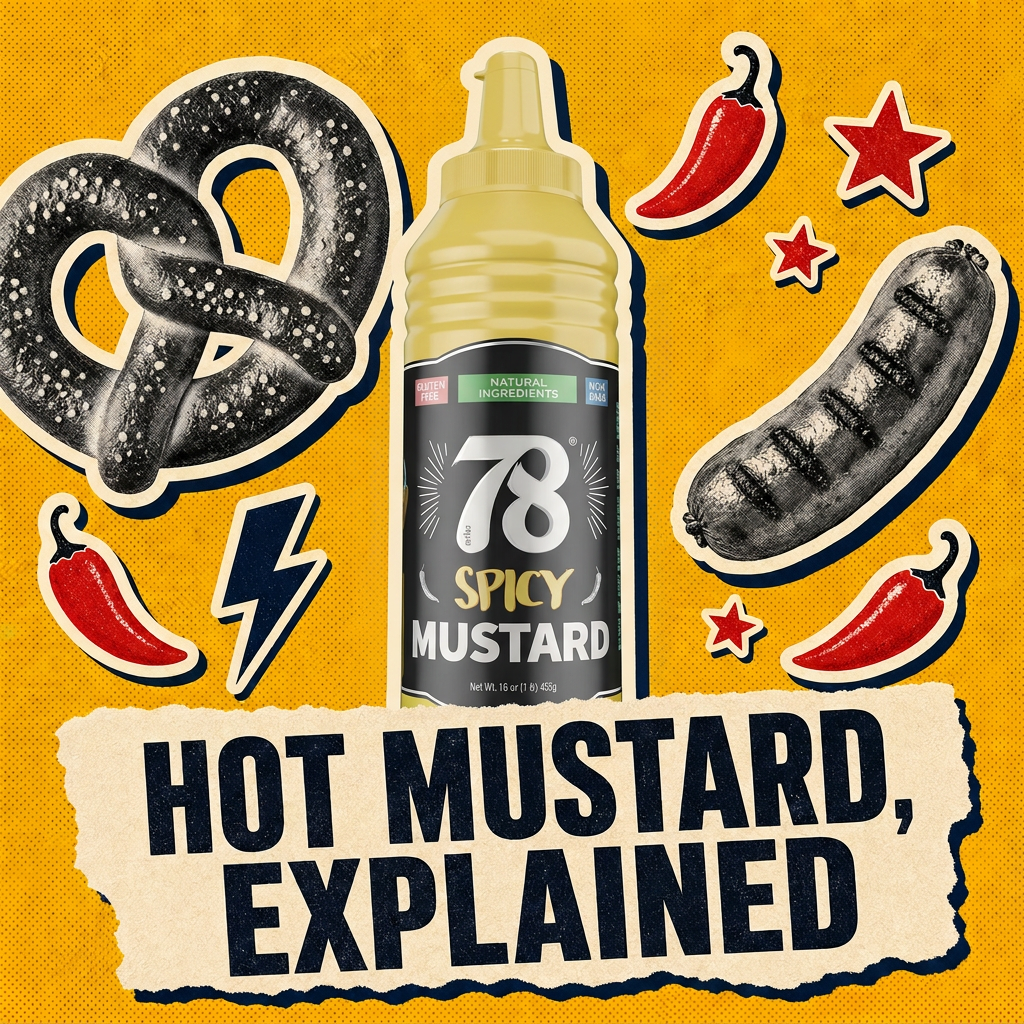
Two jars on a deli counter, both labeled hot. The first one clears your sinuses in about a second and is gone before you swallow. The second one warms slowly, spreads across your tongue, and is still there when you reach for the pretzel again.
Both are hot mustard. They are hot in completely different ways, and once you know why, picking the right one for a brat, a pastrami sandwich, or an egg roll gets easy.
Why this matters
Two kinds of heat
Seed heat comes from the mustard seed itself. It is sharp, it climbs into your nose, and it fades fast. Pepper heat comes from capsaicin in chili peppers. It builds slower, sits on the tongue, and lingers. Most hot mustards are one or the other. A few, including ours, use white mustard seed for body and real peppers for the heat, which is why 78 Spicy warms instead of spikes.
The chemistry in one paragraph
Mustard seed stores a compound called sinigrin next to an enzyme called myrosinase, kept apart until the seed is broken. Simon Cotton, writing for the University of Bristol's Molecule of the Month series, describes what happens next: when the seed is crushed, "plant-cell walls are opened, sinigrin is released and comes into contact with the plant enzyme myrosinase. This enzyme catalyses the breakdown of sinigrin into its constituent molecules, which include allyl isothiocyanate." That last molecule is the heat. It is volatile, which is why it goes up your nose, and it triggers both the "hot" receptor (TRPV1) and the "pain" receptor (TRPA1). Capsaicin from peppers mostly hits TRPV1, which is why pepper heat feels warm instead of sharp.
The seed ladder
There are three mustard seeds in the aisle. White mustard seed (often called yellow) is the mildest; its main compound is a gentler, less volatile cousin of allyl isothiocyanate, so its heat stays on the tongue rather than shooting into the sinuses. Brown mustard seed is noticeably hotter and is the base for most deli, Dijon, and Chinese hot mustards. Black mustard seed is hottest of all and mostly shows up in Indian cooking rather than jars.
Cold water vs vinegar
The liquid decides how the heat behaves. Serious Eats sums it up: mustard made with yellow seeds and vinegar sits on the mild end, while mustard made with brown or black seeds and cold water lands on the hot and spicy side. Cold water lets the enzyme run wild, so the heat is huge and short. Acid slows the reaction, so the heat is tamer but lasts longer. That is why a fresh Chinese hot mustard peaks in minutes and a vinegar-based mustard tastes the same on day sixty.
The hot mustard heat ladder
| Style | Seed | Liquid | Heat (1 to 5) | How it hits | Put it on |
|---|---|---|---|---|---|
| Yellow | White | Vinegar | 1 | Tangy, gentle | Hot dogs, burgers |
| Deli / spicy brown | Brown | Vinegar | 3 | Sharp, gritty | Pastrami, corned beef |
| Dijon | Brown | Wine or verjus | 3 | Clean, sharp | Vinaigrettes, chicken |
| German medium-hot | Brown + white | Vinegar | 3 | Round, slightly sweet | Brats, weisswurst |
| English | White + brown | Water | 5 | Nose burn, fades | Roast beef, ham |
| Chinese hot | Brown | Water | 5 | Instant, wasabi-like | Egg rolls, dumplings |
| Pepper-hot yellow | White | Vinegar + real peppers | 3 | Slow warmth, lingers | Pretzels, brats, burgers |
Why hot mustard fades, and how to keep it
The heat molecule is volatile. Over time, and faster in a warm kitchen, it evaporates and the mustard mellows. Keep it sealed and in the fridge after opening, and buy sizes you will finish. Powdered mustards mixed with water are hottest a few minutes after mixing and lose their edge within the hour.
How to pick by use
Pretzels and brats: pepper-hot yellow or German. Pastrami and corned beef: deli brown. Egg rolls and dumplings: Chinese hot, mixed fresh. Roast beef and ham: English, sparingly. Dressings and pan sauces: Dijon.
Where 78 Spicy sits
78 Spicy Mustard is a hot yellow mustard: six ingredients, water, white mustard seed, vinegar, sugar, salt, and a blend of real peppers in the spices. No horseradish. It is mustard-seed rich and less vinegar-forward than most yellow mustards, so the seed comes through first and the pepper warmth follows. On the ladder it sits above a classic yellow and well below a Chinese hot, with heat that stays on the tongue instead of spiking in the nose. Non-GMO certified, gluten-free, no dyes.
The bottom line
Ask what kind of hot you want. Nose heat that vanishes: reach for English or Chinese hot. Tongue warmth that stays: reach for a pepper-hot yellow. Then match the liquid to the dish, vinegar for the table, water for the moment.